
Hiatal hernia and reflux surgery in Vienna
Heartburn and acid reflux are often caused by a hiatal hernia. When lifestyle changes and medication are not enough, a minimally invasive anti-reflux operation offers a permanent solution for most patients – laparoscopically or with the da Vinci robot.
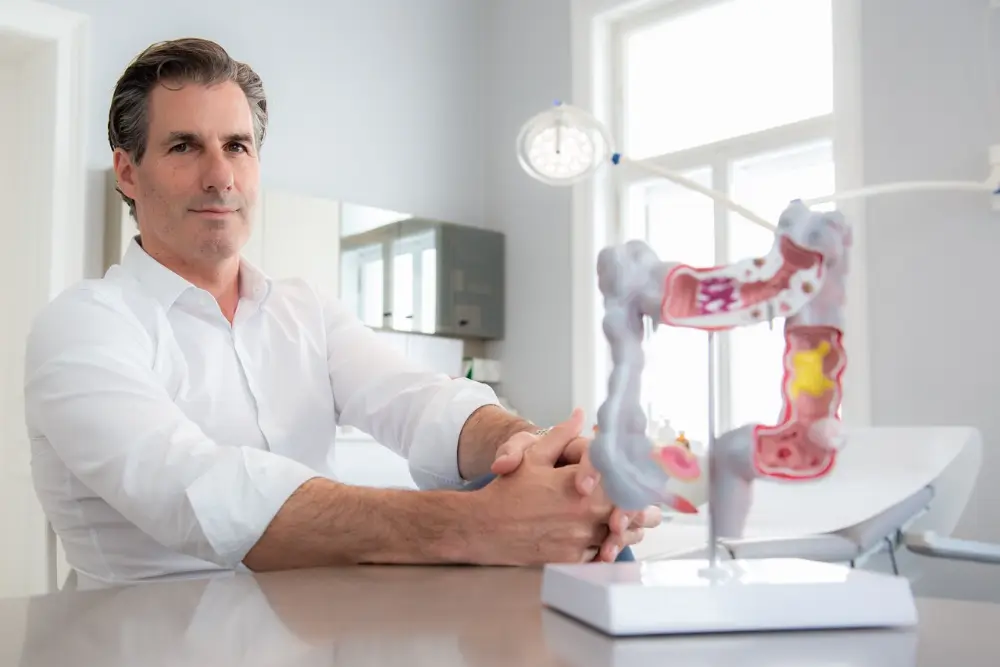
What are reflux and a hiatal hernia?
In reflux disease, stomach contents flow back into the oesophagus. Normally a sphincter muscle at the junction of oesophagus and stomach prevents this. A hiatal hernia – where part of the stomach slides through the diaphragm into the chest – is often a contributing cause. More than 7% of Austrians suffer from reflux symptoms.
Symptoms
- Heartburn – a burning pain or pressure behind the breastbone
- Acid regurgitation
- Hoarseness in the morning
- Chronic cough or recurrent bronchitis
Over time, reflux can damage the lining of the oesophagus and – rarely – increase the risk of oesophageal cancer. Regular gastroscopy is therefore important.
Treatment options
The first step is usually a change in diet and lifestyle, which brings significant relief for many patients. Acid-reducing medication lowers stomach acid but cannot stop reflux itself, and long-term use can have considerable side effects. When these measures are not enough, surgery offers a permanent cure for most patients.
Examinations before surgery
- Gastroscopy – essential for every reflux patient
- Video-fluoroscopy to visualise swallowing
- Oesophageal manometry to measure the function of the oesophageal muscles (about 20 minutes)
- 24-hour pH monitoring to record acid exposure of the oesophagus
Reflux surgery: hiatoplasty and Toupet fundoplication
The operation is performed laparoscopically (keyhole surgery) under general anaesthesia and takes one to two hours. It can also be performed with the da Vinci robot – I carried out the first such procedures in an Austrian private hospital.
- Hiatoplasty: the widened opening in the diaphragm is narrowed to its normal size and the stomach is returned to the abdomen
- Fundoplication: the upper part of the stomach is wrapped around the lower oesophagus to create a new valve
- I use the Toupet technique (270° wrap), which causes fewer early side effects than the Nissen technique (360° wrap)
90–95% of patients achieve long-term freedom from reflux. About 20% may experience reflux symptoms again after 15–20 years.
After your operation
- Most patients go home the day after surgery
- Moderate pain relief is needed for a few days only; early mobilisation is encouraged
- Liquid and soft food for the first two weeks, while post-operative swelling makes the wrap temporarily tighter – then a normal diet
- No heavy lifting or straining for two months
- Temporary swallowing difficulties, bloating or difficulty vomiting can occur early on, but are less common with the Toupet technique
Book your consultation
Practices at the Wiener Privatklinik (Lazarettgasse 25, 1090 Vienna) and in the city centre (Rosengasse 8/5, 1010 Vienna). Surgery dates, prices and medical questions: +43 680 330 11 45
Priv. Doz. Dr. Emanuel Sporn – specialist in general, visceral and vascular surgery, international specialist in hernia surgery, Vienna.